

How To Draw Price Effect And Quantity Effect
Topic 4 Role i: Elasticity
4.2 Elasticity and Revenue
Learning Objectives
By the end of this section, you will exist able to:
- Analyze graphs in order to allocate elasticity equally constant unitary, infinite, or nada
- Describe the cost effect and the quantity event
- Clarify how price elasticities touch revenue and expenditure
In Topic iv.1, we introduced the concept of elasticity and how to calculate it, but we didn't explain why it is useful. Recall thatelasticity measures responsiveness of one variable to changes in another variable. If yous owned a coffee shop and wanted to increase your prices, this 'responsiveness' is something you need to consider. When you increase prices, you know quantity volition fall, but past how much?
Elasticities tin exist divided into three broad categories: rubberband, inelastic, and unitary. Anelastic need is one in which the elasticity is greater than one, indicating a loftier responsiveness to changes in price. Elasticities that are less than one indicate low responsiveness to price changes and correspond toinelastic demand.Unitary elasticities betoken proportional responsiveness of either demand or supply, as summarized in the following table:
| If . . . | Then . . . | And It Is Called . . . |
|---|---|---|
| [latex]\%\;change\;in\;quantity > \%\;alter\;in\;cost[/latex] | [latex]\frac{\%\;change\;in\;quantity}{\%\;change\;in\;price)} > 1[/latex] | Elastic |
| [latex]\%\;change\;in\;quantity = \%\;modify\;in\;price[/latex] | [latex]\frac{\%\;change\;in\;quantity}{\%\;alter\;in\;cost)} = 1[/latex] | Unit Elastic |
| [latex]\%\;change\;in\;quantity < \%\;alter\;in\;price[/latex] | [latex]\frac{\%\;change\;in\;quantity}{\%\;change\;in\;price)} < 1[/latex] | Inelastic |
| Elastic, Inelastic, and Unitary: Iii Cases of Elasticity | ||
If nosotros were to calculate elasticity at every signal on a demand curve, we could divide it into these elastic, unit elastic, and inelastic areas, every bit shown in Figure 4.2a. This means the impact of a toll modify will depend on where nosotros are producing. Feel gratis to calculate the elasticity in any of the regions, you lot will find that it indeed fits the clarification.
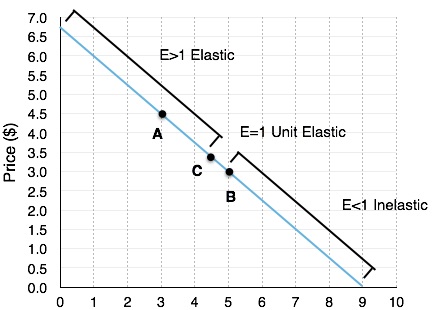
To demonstrate, nosotros accept calculated the elasticities at a point in each of the zones:
Point A =[latex]\frac{\Delta Q}{\Delta P}\cdot \frac{P}{Q}=\frac{9}{6.75}\cdot \frac{4.v}{iii}=2[/latex] =Elastic
Bespeak B = [latex]\frac{\Delta Q}{\Delta P}\cdot \frac{P}{Q}=\frac{ix}{6.75}\cdot \frac{iii}{v}=0.8[/latex] =Inelastic
Betoken C =[latex]\frac{\Delta Q}{\Delta P}\cdot \frac{P}{Q}=\frac{9}{6.75}\cdot \frac{three.375}{four.5}=1[/latex] =Unit Rubberband
In reality, the only indicate we demand to find to determine which areas are elastic and inelastic is our indicate where elasticity is ane, or Indicate C. This isn't as difficult as it may seem. Since our formula is equal to the changed of our slope multiplied by a betoken on the graph, it volition only equal 1 when our point is equal to the slope of our graph. For a linear graph, this but occurs at the centre point, which is (4.5, 3.325) in this example.
Why is This Useful?

So far, we take adamant how to calculate elasticity at and between different points, but why is this knowledge useful?
Consider a coffee shop owner considering a price hike. The owner has ii things to account for when deciding whether to enhance the cost, ane that increases acquirement and one that decreases information technology. Elasticity helps us determine which effect is greater. Referring back to our table:
- When you increase price, you lot increase revenue on units sold(The Price Effect).
- When you lot increase price, you sell fewer units(The Quantity Result).
These two effects work against each-other. To make up one's mind which outweighs the other we tin can look at elasticity:
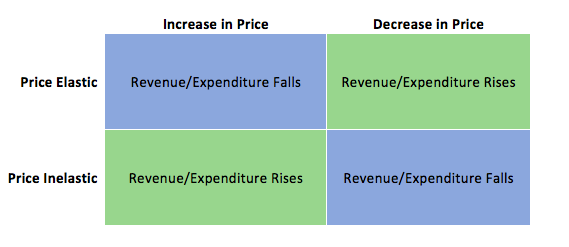
When our point iselasticour [latex]\%\;change\;in\;quantity > \%\;change\;in\;toll[/latex] meaning if we increment cost, our quantity effect outweighs the price result, causing a decrease in revenue.
When our signal isinelastic our [latex]\%\;change\;in\;quantity < \%\;change\;in\;price[/latex] meaning if nosotros increase price, our cost effect outweighs the quantity effect, causing a increment in acquirement. This information is summarized in Figure 4.2b:
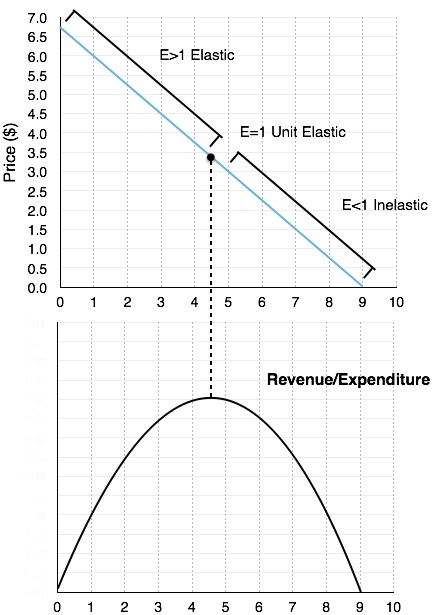
The starting time thing to note is that acquirement is maximized at the point where elasticity is unit elastic. Why? If you are the java shop owner, you volition notice that at that place are untapped opportunities when demand is elastic or inelastic.
If rubberband:The quantity effect outweighs the toll consequence, significant if nosotros decrease prices, the revenue gained from the more units sold will outweigh the acquirement lost from the decrease in price.
If inelastic:The price issue outweighs the quantity effect, meaning if nosotros increase prices, the revenue gained from the higher toll will outweigh the acquirement lost from less units sold.
The effects of price increase and decrease at different points are summarized in Figure iv.2c.
What nearly Expenditure
You will notice that expenditure is mentioned whenever revenue is. This is because a dollar earned by the coffee shop corresponds to a dollar spent by the consumer. Therefore, if the firm'south acquirement is ascension, then the consumer's expenditure is rising likewise. You must empathise how to respond questions from both sides.
Summary
Elasticity is used to measure the responsiveness of one variable to some other. This responsiveness tin can be labelled equally rubberband (e > i), unit rubberband (e = 1), and inelastic (e < ane). We tin can apply this to the demand bend, with unit elastic respective to the middle of the need curve (10-intercept/two , y-intercept/2). Everything to the left is elastic and everything to the right is inelastic. This information tin be used to maximize revenue or expenditure, with the understanding that when elastic, the quantity consequence outweighs the price effect, and when inelastic, the price result outweighs the quantity effect.
Glossary
- Elastic
- when the elasticity is greater than one, indicating that a ane percentage increase in price will result in a more than than 1 percent increase in quantity; this indicates a high responsiveness to price.
- Inelastic
- when the elasticity is less than ane, indicating that a ane pct increase in toll paid to the house will result in a less than 1 percent increase in quantity; this indicates a depression responsiveness to price.
- Unitary elastic
- when the calculated elasticity is equal to 1 indicating that a alter in the price of the good or service results in a proportional change in the quantity demanded or supplied
Exercises 4.two
Use the demand curve diagram below to answer the following 2 questions.
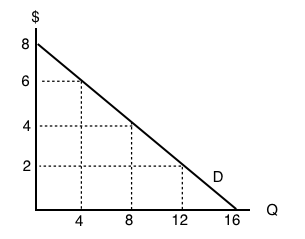
one. What is the own-cost elasticity of need equally price decreases from $8 per unit to $half dozen per unit? Use the mid-bespeak formula in your calculation.
a) Infinity.
b) 7.0
c) ii.0.
d) ane.75
ii. At what signal is demand unit-rubberband?
a) P = $vi, Q = 12.
b) P = $4, Q = 8.
c) P = $two, Q = 12.
d) None of the above.
iii. Which of the following statements about the relationship betwixt the price elasticity of demand and revenue is Truthful?
a) If demand is price inelastic, then increasing price will decrease acquirement.
b) If need is cost rubberband, then decreasing toll will increase revenue.
c) If demand is perfectly inelastic, then revenue is the same at any cost.
d) Elasticity is constant along a linear demand curve and so too is revenue.
iv. Suppose BC Ferries is considering an increment in ferry fares. If doing so results in an increment in revenues raised, which of the following could be the value of the ain-cost elasticity of demand for ferry rides?
a) 0.v.
b) 1.0.
c) 1.five.
d) All of the above.
v. Use the need diagram beneath to answer this question. Note that P × Q equals $900 at every signal on this need curve.
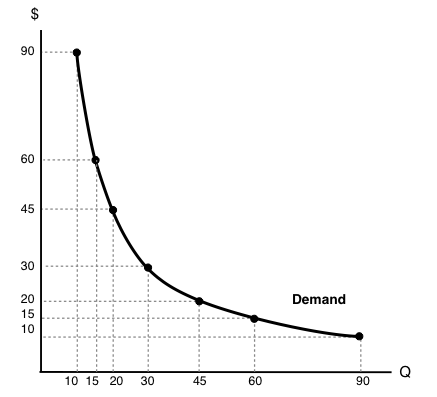
Which of the following statements correctly describes own-price elasticity of demand, for this particular demand bend?
I. Need is unit elastic at a price of $30, and rubberband at all prices greater than $30.
Ii. Demand is unit elastic at a price of $30, and inelastic at all prices less than $30.
III. Need is unit of measurement elastic for all prices.
a) I and II merely.
b) I only.
c) I, 2 and III.
d) 3 but.
half-dozen. Suppose that, if the price of a good falls from $10 to $8, full expenditure on the good decreases. Which of the following could be the (absolute) value for the own-price elasticity of demand, in the cost range considered?
a) 1.half dozen.
b) 2.iii.
c) Both a) and b).
d) Neither a) or b).
vii. Consider the demand curve drawn below.
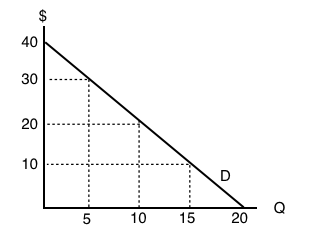
At which of the following prices and quantities is acquirement maximized?
a) P = forty; Q = 0.
b) P = 30; Q = 5.
c) P = 20; Q = x.
d) P = 0; Q = xx.

Source: https://pressbooks.bccampus.ca/uvicecon103/chapter/4-4-elasticity-and-revenue/
Posted by: gordonhatelve.blogspot.com
0 Response to "How To Draw Price Effect And Quantity Effect"
Post a Comment