

Look At The Drawing. What Would Most Likely Cause The Rock To Break Apart?
Weathering describes the breaking down or dissolving of rocks and minerals on the surface of the Globe. H2o, water ice, acids, salts, plants, animals, and changes in temperature are all agents of weathering. Once a rock has been cleaved down, a process called erosion transports the bits of rock and mineral abroad. No rock on Earth is hard enough to resist the forces of weathering and erosion. Together, these processes carved landmarks such equally the Grand Coulee, in the U.South. state of Arizona. This massive canyon is 446 kilometers (277 miles) long, every bit much every bit 29 kilometers (18 miles) wide, and 1,600 meters (ane mile) deep. Weathering and erosion constantly change the rocky mural of World. Weathering wears away exposed surfaces over time. The length of exposure often contributes to how vulnerable a rock is to weathering. Rocks, such as lavas, that are quickly buried beneath other rocks are less vulnerable to weathering and erosion than rocks that are exposed to agents such as wind and water. As information technology smoothes rough, sharp stone surfaces, weathering is frequently the kickoff footstep in the production of soils. Tiny $.25 of weathered minerals mix with plants, beast remains, fungi, bacteria, and other organisms. A unmarried type of weathered rock often produces infertile soil, while weathered materials from a collection of rocks is richer in mineral diversity and contributes to more fertile soil. Soils types associated with a mixture of weathered rock include glacial till, loess, and alluvial sediments. Weathering is often divided into the processes of mechanical weathering and chemical weathering. Biological weathering, in which living or once-living organisms contribute to weathering, can be a function of both processes. Mechanical Weathering Mechanical weathering, likewise called concrete weathering and disaggregation, causes rocks to crumble. Water, in either liquid or solid form, is often a key agent of mechanical weathering. For instance, liquid water can seep into cracks and crevices in rock. If temperatures driblet low enough, the h2o volition freeze. When water freezes, information technology expands. The water ice then works every bit a wedge. It slowly widens the cracks and splits the rock. When ice melts, liquid water performs the act of erosion past carrying away the tiny rock fragments lost in the dissever. This specific procedure (the freeze-thaw cycle) is called frost weathering or cryofracturing. Temperature changes tin also contribute to mechanical weathering in a process chosen thermal stress. Changes in temperature cause rock to expand (with estrus) and contract (with cold). Every bit this happens over and over again, the structure of the rock weakens. Over time, it crumbles. Rocky desert landscapes are particularly vulnerable to thermal stress. The outer layer of desert rocks undergo repeated stress equally the temperature changes from day to nighttime. Eventually, outer layers chip off in sparse sheets, a process called exfoliation. Exfoliation contributes to the formation of bornhardts, one of the nigh dramatic features in landscapes formed past weathering and erosion. Bornhardts are alpine, domed, isolated rocks often found in tropical areas. Sugarloaf Mountain, an iconic landmark in Rio de Janeiro, Brazil, is a bornhardt. Changes in pressure can also contribute to exfoliation due to weathering. In a procedure chosen unloading, overlying materials are removed. The underlying rocks, released from overlying force per unit area, can then expand. As the rock surface expands, it becomes vulnerable to fracturing in a process chosen sheeting. Another type of mechanical weathering occurs when dirt or other materials virtually rock absorb water. Clay, more porous than stone, can swell with water, weathering the surrounding, harder rock. Salt also works to weather rock in a process called haloclasty. Saltwater sometimes gets into the cracks and pores of rock. If the saltwater evaporates, salt crystals are left behind. Equally the crystals grow, they put pressure on the rock, slowly breaking it autonomously. Honeycomb weathering is associated with haloclasty. As its name implies, honeycomb weathering describes stone formations with hundreds or fifty-fifty thousands of pits formed past the growth of table salt crystals. Honeycomb weathering is common in coastal areas, where sea sprays constantly force rocks to interact with salts. Haloclasty is not limited to littoral landscapes. Salt upwelling, the geologic process in which underground salt domes expand, can contribute to weathering of the overlying stone. Structures in the ancient metropolis of Petra, Jordan, were made unstable and often complanate due to salt upwelling from the ground below. Plants and animals tin be agents of mechanical weathering. The seed of a tree may sprout in soil that has nerveless in a cracked rock. Equally the roots grow, they widen the cracks, eventually breaking the rock into pieces. Over time, trees can break apart fifty-fifty large rocks. Even modest plants, such as mosses, can enlarge tiny cracks as they abound. Animals that tunnel underground, such every bit moles and prairie dogs, also work to interruption apart rock and soil. Other animals dig and trample rock aboveground, causing rock to slowly crumble. Chemical Weathering For case, carbon dioxide from the air or soil sometimes combines with water in a process chosen carbonation. This produces a weak acid, chosen carbonic acid, that tin dissolve rock. Carbonic acid is especially constructive at dissolving limestone. When carbonic acrid seeps through limestone hole-and-corner, it tin open up huge cracks or hollow out vast networks of caves. Carlsbad Caverns National Park, in the U.South. state of New Mexico, includes more than 119 limestone caves created by weathering and erosion. The largest is called the Large Room. With an area of well-nigh 33,210 square meters (357,469 foursquare feet), the Large Room is the size of six football game fields. Sometimes, chemical weathering dissolves big portions of limestone or other rock on the surface of the Earth to course a landscape called karst. In these areas, the surface rock is pockmarked with holes, sinkholes, and caves. I of the world'due south most spectacular examples of karst is Shilin, or the Stone Forest, nigh Kunming, Communist china. Hundreds of slender, sharp towers of weathered limestone rise from the landscape. Another blazon of chemical weathering works on rocks that incorporate fe. These rocks turn to rust in a process called oxidation. Rust is a compound created by the interaction of oxygen and atomic number 26 in the presence of water. As rust expands, it weakens stone and helps suspension it apart. Hydration is a form of chemical weathering in which the chemical bonds of the mineral are changed as it interacts with h2o. One instance of hydration occurs as the mineral anhydrite reacts with groundwater. The h2o transforms anhydrite into gypsum, one of the most mutual minerals on Earth. Another familiar form of chemical weathering is hydrolysis. In the process of hydrolysis, a new solution (a mixture of two or more substances) is formed as chemicals in rock interact with water. In many rocks, for example, sodium minerals interact with water to form a saltwater solution. Hydration and hydrolysis contribute to flared slopes, another dramatic example of a landscape formed by weathering and erosion. Flared slopes are concave rock formations sometimes nicknamed "moving ridge rocks." Their c-shape is largely a result of subsurface weathering, in which hydration and hydrolysis vesture away rocks beneath the landscape's surface. Living or once-living organisms can as well exist agents of chemical weathering. The decaying remains of plants and some fungi form carbonic acid, which can weaken and dissolve rock. Some leaner can weather rock in order to access nutrients such as magnesium or potassium. Clay minerals, including quartz, are amid the most common byproducts of chemical weathering. Clays brand upward about twoscore% of the chemicals in all sedimentary rocks on World. Weathering and People Weathering is a natural process, but human being activities can speed it up. For example, certain kinds of air pollution increase the rate of weathering. Burning coal, natural gas, and petroleum releases chemicals such as nitrogen oxide and sulfur dioxide into the atmosphere. When these chemicals combine with sunlight and moisture, they change into acids. They then fall dorsum to Earth as acid pelting. Acid rain quickly weathers limestone, marble, and other kinds of stone. The furnishings of acid rain can frequently be seen on gravestones, making names and other inscriptions impossible to read. Acid pelting has also damaged many historic buildings and monuments. For example, at 71 meters (233 feet) tall, the Leshan Behemothic Buddha at Mountain Emei, Red china is the globe's largest statue of the Buddha. It was carved 1,300 years ago and sabbatum unharmed for centuries. An innovative drainage system mitigates the natural procedure of erosion. But in recent years, acid pelting has turned the statue'southward nose blackness and made some of its hair crumble and autumn.
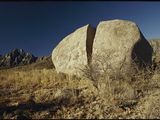
Weathering past h2o'south freeze-thaw wheel has divide this rock in two.
Photograph by George F. Mobley, National Geographic
Spheroidal Weathering
Spheroidal weathering is a class of chemical weathering that occurs when a rectangular cake is weathered from three sides at the corners and from two sides along its edges. It is besides called "onion skin" weathering.
Weathered Mountains
The Appalachian Mountains in eastern Due north America once towered more than ix,000 meters (xxx,000 anxiety) high—taller than Mount Everest! Over millions of years, weathering and erosion accept worn them down. Today, the highest Appalachian peak reaches but 2,037 meters (6,684 feet) high.
acid
Noun
chemical compound that reacts with a base to grade a table salt. Acids can corrode some natural materials. Acids accept pH levels lower than 7.
acid rain
Noun
precipitation with loftier levels of nitric and sulfuric acids. Acrid rain tin can be manmade or occur naturally.
Noun
harmful chemicals in the atmosphere.
alluvial
Describing word
having to practise with thing deposited by flowing water (alluvium).
anhydrite
Noun
(CaSOiv) grey-white mineral plant in sedimentary rocks. Also known as anhydrous calcium sulfate.
Substantive
layers of gases surrounding a planet or other celestial body.
biological weathering
Noun
process in which living or once-living organisms contribute to the disintegration of rocks and minerals (weathering).
bornhardt
Noun
isolated rock outcropping shaped as a steep-sided dome at to the lowest degree thirty meters (100 anxiety) tall.
Buddha
Noun
(c. 563-483 BCE) Indian prince, spiritual leader, and founder of the Buddhist religion. Also chosen Prince Siddhartha and Gautama Buddha.
byproduct
Noun
substance that is created by the production of another fabric.
Noun
deep, narrow valley with steep sides.
carbonation
Noun
assimilation of, or reaction with, carbon dioxide.
carbonic acrid
Noun
chemical produced as carbon dioxide dissolves in water.
cave
Noun
secret chamber that opens to the surface. Cave entrances can exist on land or in h2o.
chemical bond
Substantive
attraction between atoms, ions or molecules that enables the formation of chemic compounds.
chemical weathering
Noun
process changes the composition of rocks, ofttimes transforming them when water interacts with minerals to create diverse chemic reactions.
clay
Noun
type of sedimentary rock that is able to be shaped when wet.
Noun
dark, solid fossil fuel mined from the world.
concave
Describing word
curving inwards.
contract
Verb
to shrink or get smaller.
crack
Substantive
crevice in a rock.
cryofracturing
Noun
chemical weathering process in which the freeze-thaw bicycle of ice cracks and disintegrates stone. Also called frost weathering.
crystal
Noun
blazon of mineral that is clear and, when viewed under a microscope, has a repeating pattern of atoms and molecules.
decay
Verb
to rot or decompose.
Noun
area of land that receives no more than 25 centimeters (10 inches) of precipitation a twelvemonth.
disaggregation
Substantive
process of rocks crumbling due to pelting, wind, or other atmospheric conditions. As well chosen mechanical weathering and concrete weathering.
dissolve
Verb
to break up or disintegrate.
drainage system
Noun
series of pipes, gutters, or other waterways used to acquit off backlog water.
Substantive
human action in which world is worn away, often by water, wind, or ice.
evaporate
Verb
to alter from a liquid to a gas or vapor.
exfoliation
Noun
process describing the peeling abroad of outer layers, such as tree bark or rock sheeting.
expand
Verb
to grow or become larger.
fertile
Adjective
able to produce crops or sustain agriculture.
flared slope
Substantive
C-shaped landform consisting of a concave rock wall formed by weathering and erosion of subsurface rocks. Too chosen a "wave rock."
freeze
Noun
weather pattern of temperatures below 0 degrees Celsius (32 degrees Fahrenheit).
frost weathering
Noun
chemical weathering process in which the freeze-thaw bicycle of ice cracks and disintegrates stone. Also called cryofracturing.
geologic
Adjective
having to do with the physical formations of the Earth.
gravestone
Noun
stone marker a person'due south burial place, often engraved with the person's name and dates of nascence and decease.
Noun
water found in an aquifer.
gypsum
Noun
(hydrated calcium sulfate, CaSO4) soft, colorless or white mineral.
haloclasty
Noun
type of physical weathering caused past the growth of salt crystals in and effectually rocks.
hydration
Substantive
process of a substance or solution chemically combining with h2o.
hydrolysis
Noun
process in which a chemical compound is split into other compounds by reacting with water.
iconic
Adjective
event or symbol representing a conventionalities, nation, or community.
innovative
Describing word
new, advanced, or original.
inscription
Noun
record that has been cutting, impressed, painted, or written on a hard surface.
Substantive
landscape fabricated of limestone.
landmark
Noun
a prominent feature that guides in navigation or marks a site.
Noun
the geographic features of a region.
lava
Noun
molten stone, or magma, that erupts from volcanoes or fissures in the Globe's surface.
limestone
Noun
type of sedimentary rock generally made of calcium carbonate from shells and skeletons of marine organisms.
Noun
windblown soil or silt.
marble
Substantive
type of metamorphic rock.
mechanical weathering
Substantive
process of rocks aging due to rain, wind, or other atmospheric weather condition. Too chosen concrete weathering.
mineral
Substantive
nutrient needed to assist cells, organs, and tissues to function.
mitigate
Verb
to lower the severity of a natural or human condition.
molecular
Adjective
having to exercise with the smallest physical unit of a substance.
monument
Noun
large structure representing an event, thought, or person.
Noun
type of fossil fuel fabricated upward by and large of the gas methane.
network
Noun
series of links along which movement or advice can take place.
Noun
substance an organism needs for free energy, growth, and life.
oxidation
Noun
chemical process of a substance combining with oxygen to change the substance's physical and molecular construction.
Noun
fossil fuel formed from the remains of ancient organisms. Also chosen crude oil.
concrete weathering
Noun
procedure of rocks crumbling due to rain, wind, or other atmospheric conditions. Besides called mechanical weathering.
pockmarked
Adjective
scarred with many small indentations.
porous
Describing word
full of tiny holes, or able to exist permeated by water.
pressure
Substantive
force pressed on an object by another object or condition, such as gravity.
quartz
Noun
common type of mineral.
remains
Substantive
materials left from a dead or absent-minded organism.
stone
Noun
natural substance equanimous of solid mineral affair.
root
Noun
part of a plant that secures information technology in the soil, obtains water and nutrients, and often stores nutrient made by leaves.
rust
Verb
to dissolve and class a brittle coating, every bit iron does when exposed to air and moisture.
salt
Noun
(sodiumchloride,NaCl)crystalline mineral often used as a seasoning or preservative for food.
salt dome
Noun
structure formed as h2o evaporates from a salty lake or ocean. The remaining table salt is buried by sediments, but eventually pierces through the rock, forming a hill.
salt upwelling
Noun
process in which underground table salt domes expand, impacting surrounding rock layers.
Noun
solid fabric transported and deposited by water, ice, and wind.
Substantive
stone formed from fragments of other rocks or the remains of plants or animals.
seed
Noun
part of a constitute from which a new plant grows.
sheeting
Noun
blazon of physical weathering in which a single layer of stone is broken off. As well called profile weathering.
Noun
hole formed in a rock or other solid material by the weight or motion of water.
soil
Noun
top layer of the Earth'due south surface where plants can grow.
solution
Noun
substance in which a gas, liquid, or solid is evenly distributed in some other medium.
subsurface
Describing word
beneath the surface or upper layer.
Noun
degree of hotness or coldness measured past a thermometer with a numerical calibration.
thermal stress
Noun
strain on cloth ordinarily associated with expansion and contraction due to temperature changes.
till
Noun
rock, globe, and gravel left behind by a retreating or melting glacier.
tropical
Adjective
existing in the torrid zone, the latitudes between the Tropic of Cancer in the northward and the Tropic of Capricorn in the south.
vast
Adjective
huge and spread out.
vulnerable
Adjective
capable of existence hurt.
Substantive
the breaking down or dissolving of the Earth'due south surface rocks and minerals.
wedge
Substantive
triangle shape.

Source: https://www.nationalgeographic.org/encyclopedia/weathering/
Posted by: gordonhatelve.blogspot.com
0 Response to "Look At The Drawing. What Would Most Likely Cause The Rock To Break Apart?"
Post a Comment